Systems thinking

32 funding combinations became one flow for Brand, Publisher and Finance

ROAS Target & Budget Tool · Associate UX Designer · With Brand, Publisher and Finance · 2025

32 → 1

Valid combinations, one flow

design fact

3

Roles served: Brand, Publisher, Finance

design fact

4 × 4 × 2

Target types × budget types × org levels

design fact

Org level
ROASDrive salesMax CPAMax conv. Fixed fee CPA Fee + CPA Open ended

1 of 32: ROAS target · Fixed fee budget · Affinity level

32 valid target, budget and org-level combinations. One highlighted cell is one configuration, not one screen. Try it.

The problem

Affinity runs campaigns across several ad products for three roles: Brand, Publisher and Finance. Each needs to set or check what a campaign is trying to achieve and how it is funded. Six rounds of design were drifting toward a separate screen for every combination.

The question was not which screen each combination gets. It was how many choices one person actually makes.

Two questions shaped the scope.

A

Setting a target

What am I optimising for, and how is it funded?

Decision 01

Ask two questions of four, not one of sixteen

Tension
Each target type needs different inputs. A screen per combination means 16+ near-identical flows to build, test and re-teach.
Rejected
A wizard per target and budget pairing: the usual default, and 16× the engineering and QA surface for one underlying object.
Result
One create flow. Pick what to optimise for, then how it is funded. Fields appear only when they apply.
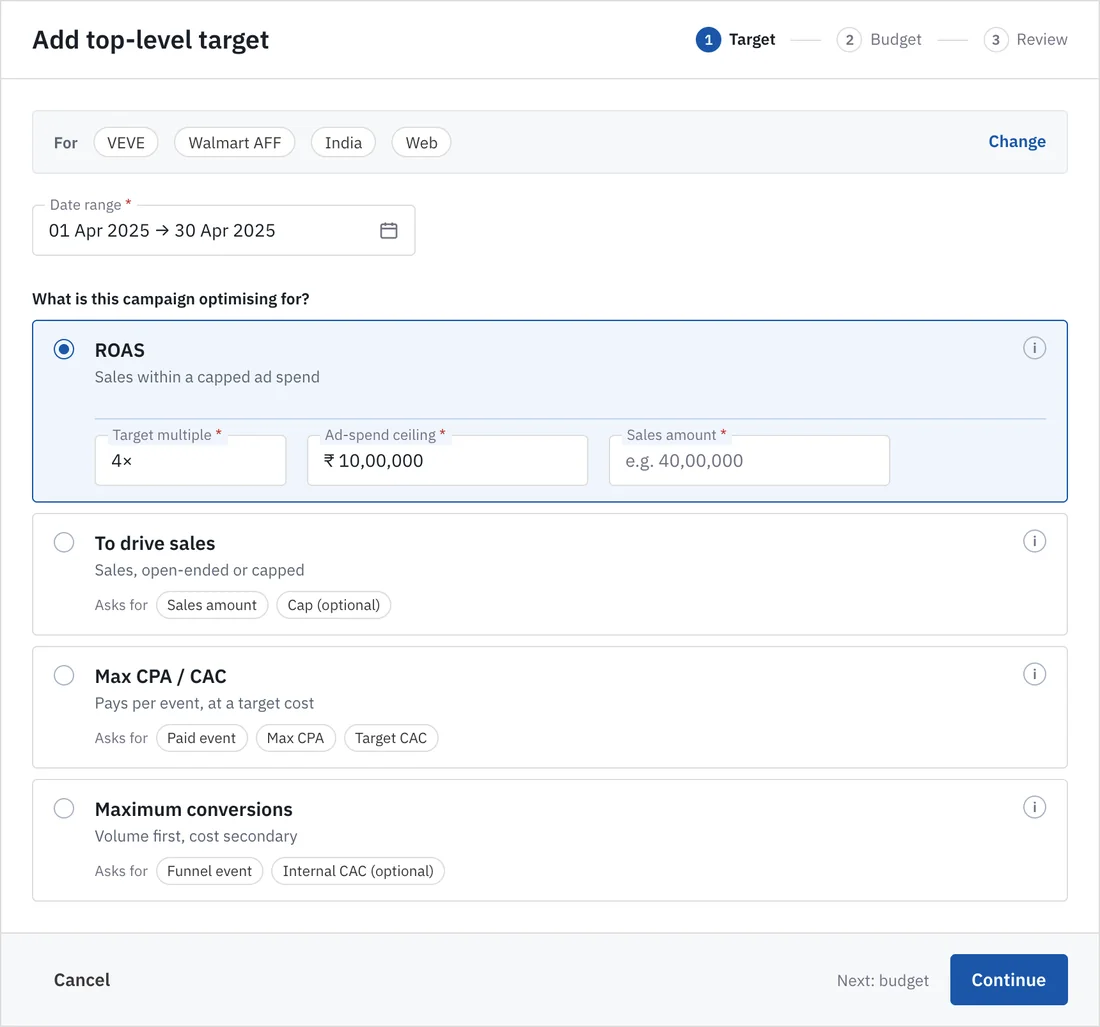
Add top-level target, step 1 of 3. Four target-type options as a radio list. ROAS is selected and reveals only its three fields; the others each list what they will ask for.
1Only the chosen option’s fields appear2Other options say what they will ask forRefined mock-up, illustrative data.

Decision 02

Make uncovered tags the headline, before launch

Tension
With dozens of tags across many targets, a flat list cannot show which ones no target covers.
Rejected
A flat list or free-text field: the lightest build, and it hides the exact gap this system exists to prevent.
Result
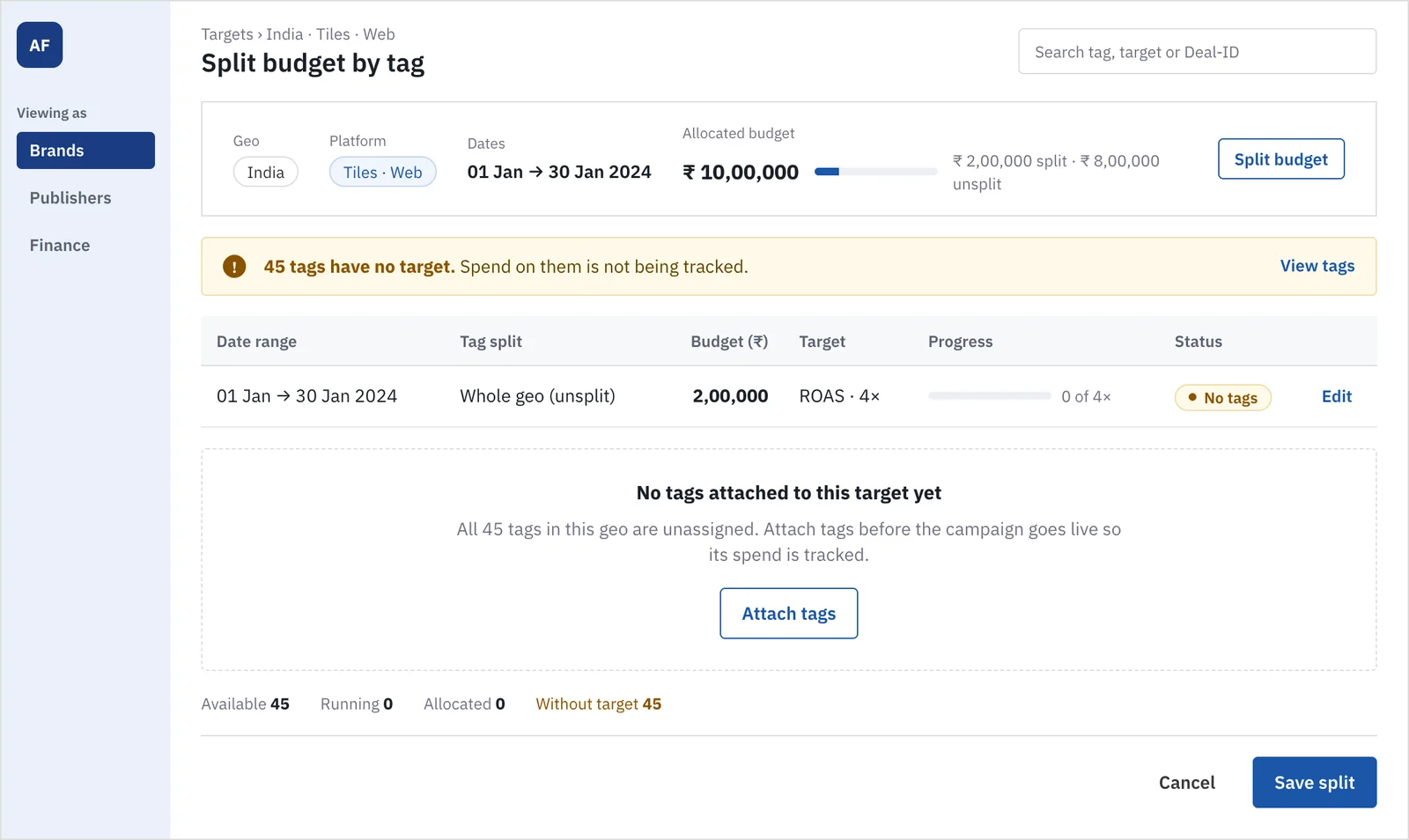
One alert leads with the count of tags without a target, so orphaned tags show up before spend goes out untracked.
Split budget by tag. One alert says 45 tags have no target, with a View tags link. A progress bar shows how much budget is split. An empty state offers Attach tags.
1One alert, with its consequence2An empty state that says what to doRefined mock-up, illustrative data.

B

Getting it billed

Can Finance invoice it?

Decision 03

Suggest a match instead of blocking the budget

Tension
A Fixed Cost budget needs a Deal-ID under a Masterbrand a new brand may not have. The person entering it rarely owns that mapping.
Rejected
A hard error that waits for another team to fix the mapping.
Result
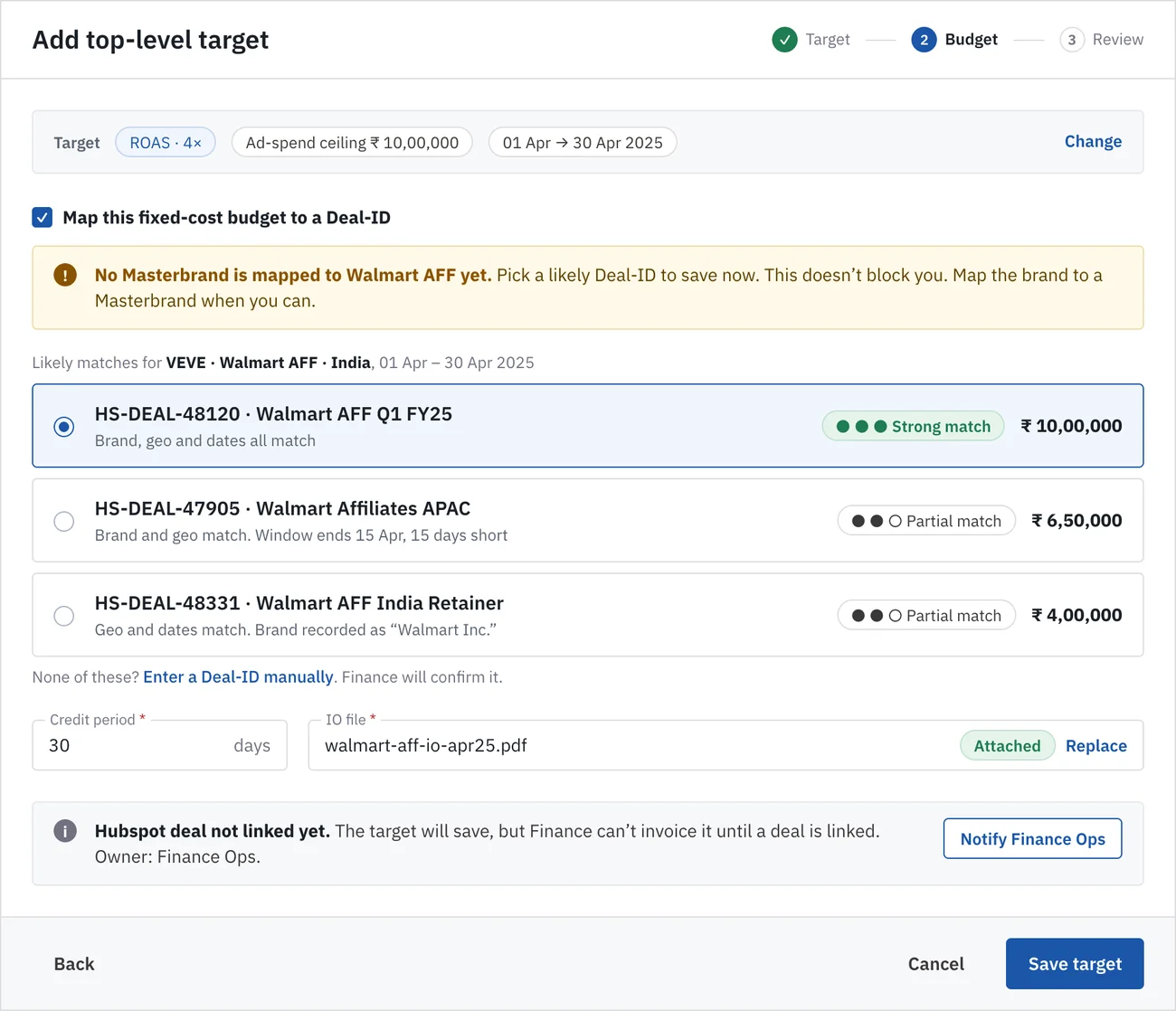
Likely Deal-IDs appear as selectable rows, with the evidence behind each match. The note says plainly that it does not block.
Fixed-cost budget Deal-ID step. One notice says no Masterbrand is mapped and that this does not block. Three likely Deal-IDs are rated strong or partial match, each with an amount.
1“This doesn’t block you”2Matches are rated strong or partialRefined mock-up, illustrative data.

Decision 04

Save unmapped targets as “Not invoiceable”

Tension
Finance cannot bill a target until it links to a Hubspot deal. When the target is created, that deal is often hard to find, or does not exist yet.
Rejected
A deal-ID text field, a required deal, and a quiet internal flag that surfaces at month-end.
Result
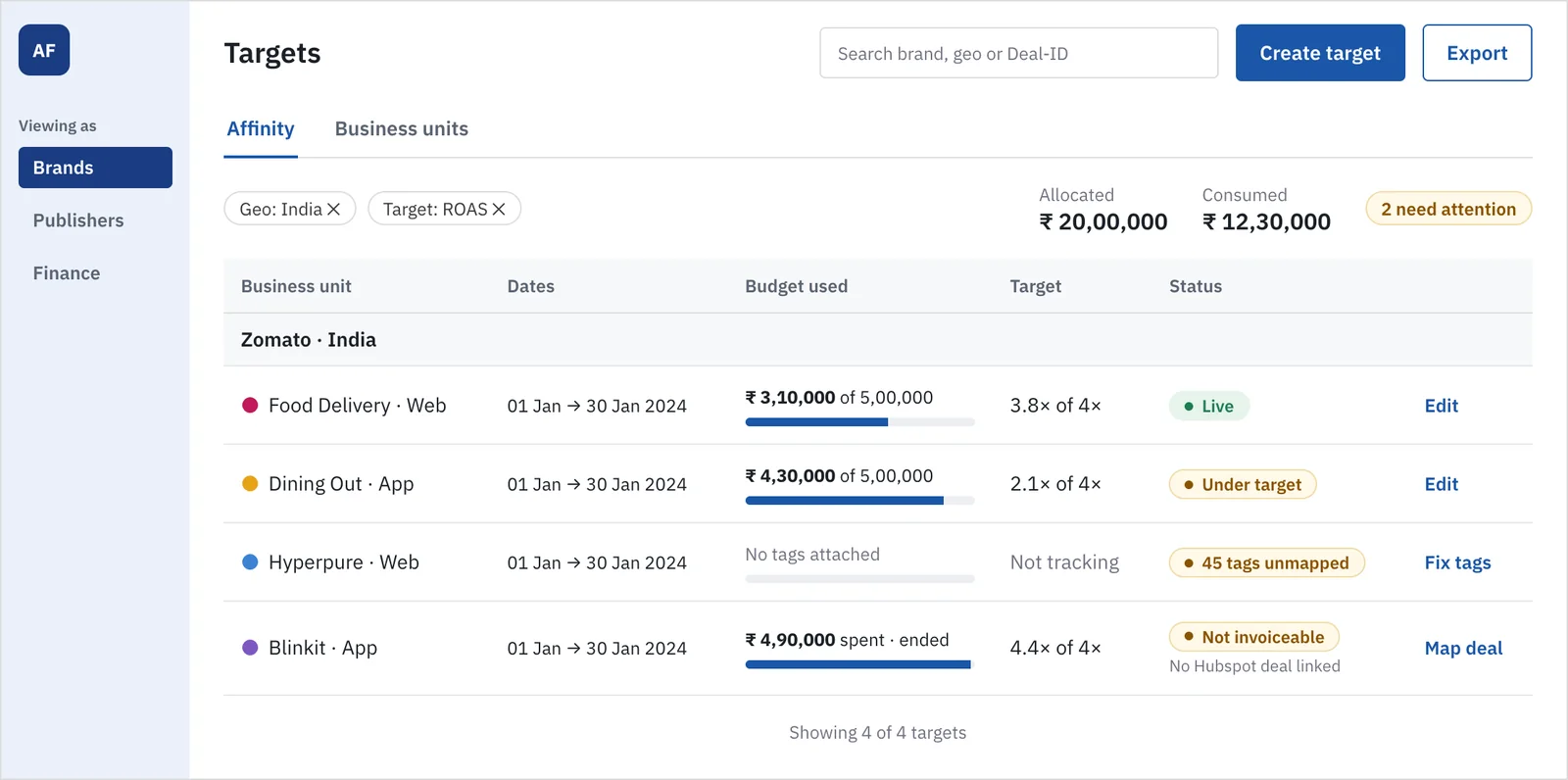
The form pre-filters Hubspot by the selections already made. With no deal yet, the target still saves and shows “Not invoiceable” on its row, visible to every role.
Targets list grouped by brand. Budget used shows a progress bar. The Status column shows Live, Under target, 45 tags unmapped and Not invoiceable, each with its own action.
145 tags unmapped, with a Fix tags action2Not invoiceable, with a Map deal actionRefined mock-up, illustrative data.

Also shipped

What I did not build

Three separate dashboards, one per role. Brand, Publisher and Finance share one configuration surface with a role switcher instead, trading per-role customisation for a single source of truth on what a target and its budget mean.

Result

32 → 1

Valid combinations, one flow

design fact

16+ → 1

Flows to build, test and re-teach

design fact

3

Roles on one shared surface

design fact